Chapter 5
Solutions for linear elastic solids
In the preceding chapter, we solved
some simple linear elastic boundary value problems. The problems were trivial, however, in that
the stress, strain and displacement fields were axially or spherically
symmetric. Most problems of practical
interest involve fully 3D stress and displamement fields.
It is extremely difficult to solve
general boundary value problems.
However, some of the best mathematicians over the past 200 years have
turned their attention to this matter, and have developed several very elegant
techniques. None of these are completely
general, but solutions derived using these techniques have provided invaluable
insight into the behavior of deformable solids.
Sadly, these days any fool with a PC
and a finite element package can solve virtually any linear elastic boundary
value problem, so you will not be able to make a living calculating exact
elasticity solutions. Nevertheless, some
exact solutions are of fundamental practical importance. Examples include
contact problems, solutions for cracks, stress concentrations, thermal stress
problems, and problems involving defects such as dislocations in solids. It is worth seeing how such solutions were
derived.
In addition, there are some very
powerful theorems in linear elasticity (such as the principle of minimum
potential energy, and the reciprocal theorem), which can be used to calculate
quantities of interest without necessarily having to solve all the governing
equations.
In this chapter, we present a very brief survey of the field
of linear elasticity. Specifically,
1. We will outline some important
general features of solutions to boundary and initial value problems;
2. We will discuss some solution
techniques and present solutions to selected boundary value problems of
interest;
3. We will discuss energy methods for
solving problems involving linear elastic solids, including the principle of
minimum potential energy, the reciprocal theorem, and the Rayleigh-Ritz method
for estimating natural frequencies of vibrating elastic solids.
5.1 General Principles
This section outlines briefly (and
mostly without proofs!) the general principles that apply to solutions to all
boundary value problems in static linear elasticity.
5.1.1 Summary of the governing
equations of linear elasticity
Static problems. We already listed the governing equations
of linear elasticity in our discussion of simple axisymmetric problems. They
are repeated here for convenience.
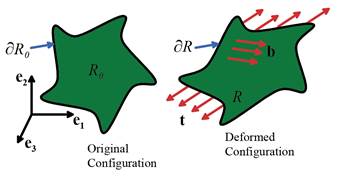
A representative problem is sketched above. We are given:
1. The shape of the solid in its
unloaded condition
2. The initial stress field in the solid
(we will take this to be zero)
3. The elastic constants for the solid and its mass density
4. The thermal expansion coefficients
for the solid, and temperature change from the initial configuration
5. A body force distribution (per unit mass) acting on the solid
6. Boundary conditions, specifying
displacements on a portion or tractions on a portion of the boundary of R
We then seek to calculate
displacements, strains and stresses satisfying the governing equations of
linear elastostatics
Dynamic problems Dynamic problems are essentially
identical, except that the boundary conditions must be specified as functions
of time, and the initial displacement and velocity field must be
specified. In this case the governing equations
are
5.1.2 Alternative form of the governing equations the Navier equation
The governing equations can be
simplified by eliminating stress and strain from the governing equations, and
solving directly for the displacements.
In this case the linear momentum balance equation (in terms of
displacement) reduces to
For the special case of an isotropic
solid with shear modulus and Poisson ratio and uniform temperature this equation reduces to
These are known as the Navier (or Cauchy-Navier) equations of
elasticity.
The boundary conditions remain as given in the preceding
section.
5.1.3 Superposition and linearity of
solutions
The governing equations of elasticity are linear.
This has two important consequences:
1. The stresses, strains and
displacements in a solid are directly proportional to the loads (or
displacements) applied to the solid.
2. If you can find two sets of
displacements, strains and stresses that satisfy the governing equations, you
can add them to create more solutions.
 These principles can be illustrated
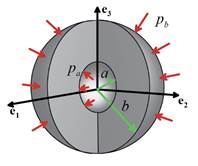
clearly using some of the simple solutions derived in Section 4.1. For example, examine the solution to the
pressurized sphere illustrated in the figure (Sect 4.1.4). As an example, the radial stress induced by
pressure on the interior, and zero pressure on the
exterior surface is
These principles can be illustrated
clearly using some of the simple solutions derived in Section 4.1. For example, examine the solution to the
pressurized sphere illustrated in the figure (Sect 4.1.4). As an example, the radial stress induced by
pressure on the interior, and zero pressure on the
exterior surface is
The radial stress induced by pressure on the exterior surface, with zero pressure on
the interior surface is
Note that in both cases the stress is directly proportional
to the pressure. In addition, to find
the radial stress by combined pressures on the interior and on the exterior surface, you can just add
these two solutions.
Further examples of
superposition and linearity will be given in subsequent sections.
5.1.4 Uniqueness and existence of
solutions to the linear elasticity equations
The following results are useful:
1. If only displacements are prescribed
on the boundary of the solid, the governing equations of linear elasticity always
have a solution, and the solution is unique.
2. If mixed boundary conditions are
specified, a static solution exists and is unique if the displacements
constrain rigid motions. A dynamic solution always exists and is unique,
provided the velocity field and displacement field at time t=0 are known.
3. If only tractions are prescribed on
the boundary, a static solution exists only if the tractions are in
equilibrium. In this case, the stresses
and strains are unique, but the displacements are not. A dynamic solution always exists and is
unique, again, providing initial conditions are known.
5.1.5 Saint-Venant’s principle
Saint-Venant’s principle is often
invoked to formulate approximate solutions to boundary value problems in linear
elasticity. For example, when we solve
problems involving bending or axial deformation of slender beams and rods in
elementary strength of materials courses, we only specify the resultant forces
acting on the ends of a rod, or the magnitudes of point forces acting on a
beam, we don’t specify the distribution of traction in detail. We rely on Saint Venant’s principle to
justify this approach. In this context, the principle states the following.
The stresses, strains and displacements far from the ends of a rod or
beam subjected to end loading depend only on the resultant forces and moments
acting on its ends, and do not depend on how the tractions themselves are
distributed.
Although SVP is widely used, it turns
out to be remarkably difficult to prove mathematically. The difficulty is partly that it is not easy
to state the principle itself precisely enough to apply any mathematical
machinery to it. A rigorous statement is
given by Sternberg (Q. J. Appl. Mech 11
p. 393 1954), among several other versions.
Here, we will just illustrate the most common applications of the
principle through specific examples.
One version of SVP can be stated as
follows.
Suppose that we calculate the stress, strain and displacement induced in
a solid by two different traction distributions and that act on some small region of a
solid with characteristic size a. If the
tractions exert the same resultant force and moment, then the stresses, strains
and displacements induced by the two traction distributions at a distance r
from the loaded region are identical for large .
In practice ‘large’
usually means .
This principle can be illustrated
using a simple example.
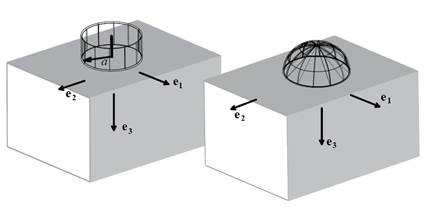
Consider a
large solid with a flat surface, as shown above. It is possible to calculate
formulas for the stresses and displacements induced by various pressure
distributions acting on the flat surface the procedure to do this will be outlined
later. For now, we will compare the
stresses induced by
1. A uniform pressure
2. A parabolic pressure
You can verify
for yourself that both pressure distributions exert a resultant force P acting in the vertical direction on
the surface, and exert zero moment about the origin. The variation of stress down the axis of
symmetry ( ), expressed in cylindrical-polar coordinates, can
be derived as
Case
1: Uniform pressure
Case 2: Parabolic
pressure
Now, to demonstrate SVP, we want to
show that the stresses are equal for large z/a. We can do this graphically The figures compare the variation of vertical and
radial stress down the axis of symmetry with z/a.
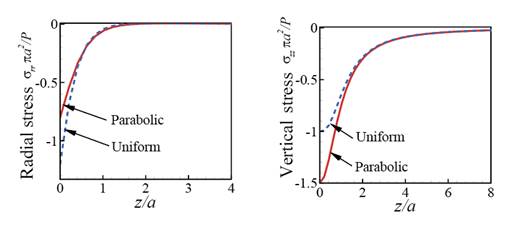
The stresses induced by the two
different pressures are clearly indistinguishable for .
This example helps to quantify what we mean by a `large’ distance.
The second commonly used application of SVP is a rather vague
statement that
A
localized geometrical feature with characteristic size R in a large solid only
influences the stress in a region with size approximately 3R surrounding the feature.
This is more a rule of thumb than a
precise mathematical statement. It can
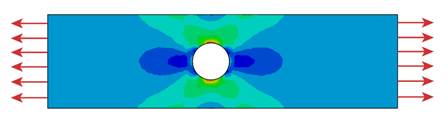
be illustrated by looking at specific solutions. For example, the figure below shows the von-Mises stress contours
surrounding a circular hole in a thin rectangular plate that is subjected to
extensional loading (calculated using the finite element method). Far from the
hole, the stress is uniform. The
contours deviate from the uniform solution in a region that is about three
times the hole radius.