5.3 Complex Variable Solution to Plane Strain Static Linear Elastic
Problems
Airy functions have been used to find
many useful solutions to plane elastostatic boundary value problems. The method does have some limitations,
however. The biharmonic equation is not
the easiest field equation to solve, for one thing. Another limitation is that
displacement components are difficult to determine from Airy functions, so that
the method is not well suited to displacement boundary value problems.
In this section we
outline a more versatile representation for 2D static linear elasticity problems,
based on complex potentials. The main
goal is to provide you with enough background to be able to interpret solutions
that use the complex variable formulation.
The techniques to derive the complex potentials are beyond the scope of
this book, but can be found in most linear elasticity texts.
 A typical plane
elasticity problem is illustrated in the figure. Just as in the preceding
section, we assume that the solid is two dimensional, which means either that
A typical plane
elasticity problem is illustrated in the figure. Just as in the preceding
section, we assume that the solid is two dimensional, which means either that
1. The solid is a thin
sheet, with small thickness h, and is
loaded only in the plane.
In this case the plane stress
solution is applicable
2. The solid is very
long in the direction, is prevented from stretching
parallel to the axis, and every cross section is loaded
identically and only in the plane.
In this case, the plane strain
solution is applicable.
Some additional basic assumptions and
restrictions are:
· The complex variable method outlined below is applicable only to
isotropic solids. We will assume that the solid has
Young’s modulus E, Poisson’s ratio and mass density
· We will assume no body forces, and constant temperature
5.3.1 Complex variable solutions to elasticity problems
 The figure shows a 2D solid. In the complex
variable formalism,
The figure shows a 2D solid. In the complex
variable formalism,
· The position of a point in the solid is specified by a
complex number
· The position of a point can also be expressed as where . You can show that
these are equivalent using Euler’s formula , which gives
· The displacement of a point is specified using a second
complex number
· The displacement and stress fields in rectangular
coordinates are generated from two complex
potentials and , which are
differentiable (also called `analytic’ or `holomorphic’) functions of z (e.g. a polynomial), using the following
formulas
Here, denotes the derivative of with respect to z, and denotes the complex conjugate of . Recall that to calculate the complex
conjugate of a complex number, you simply change the sign of its imaginary
part, i.e. .
· The displacement and stress in polar coordinates can be
derived as
· The formulas given here for displacements and stresses
are the most general representation, but other special formulas are sometimes
used for particular problems. For
example, if the solid is a half-space in the region with a boundary at the solution can be generated from a single complex potential , using the formulas
For example, you can
use these formulas to calculate stresses from the potentials given in Sections
5.3.7-5.3.9. The conventional
representation gives the same results, of course.
5.3.2 Demonstration that the complex
variable solution satisfies the governing equations
We need to show two things:
1. That the displacement field satisfies
the equilibrium equation (See sect 5.1.2)
2. That the stresses are related to the
displacements by the elastic stress-strain equations
To do this, we need to review some
basic results from the theory of complex variables. Recall that we have set , so that a differentiable function can be decomposed into real and imaginary
parts, each of which are functions of , as
This shows that
Next, recall that if is differentiable with respect to z, its real and imaginary parts must
satisfy the Cauchy-Riemann equations
We can then show that the derivative
of with respect to is zero, and similarly, the derivative of with respect to z is zero. To see these, use
the definitions and the Cauchy-Riemann equations
We can now proceed with the proof. The equilibrium equations for plane
deformation reduce to
These equations can be written in a
combined, complex, form as
It is easy to show (simply substitute
and use the definitions of differentiation
with respect to and ) that this can be re-written as
Finally, substituting
and noting that and shows that this equation is indeed satisfied.
To show that the stress-strain
relations are satisfied, note that the stress-strain relations for plane strain
deformation (Section 3.1.4) can be written as
Substituting for D in terms of the complex potentials and evaluating the derivatives
gives the required results.
5.3.3 Complex variable solution for a
line force in an infinite solid (plane strain deformation)
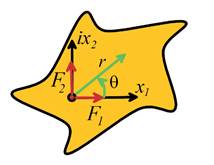 The figure shows a line load with force per unit out of plane distance acting at the origin of a large (infinite)
solid. The displacements and stresses are calculated from the complex
potentials
The figure shows a line load with force per unit out of plane distance acting at the origin of a large (infinite)
solid. The displacements and stresses are calculated from the complex
potentials
The displacements can be calculated from these potentials as
We will work through the algebra required
to calculate these formulae for displacement and stress as a representative
example. In practice a symbolic
manipulation program makes the calculations painless. To begin, note that
and
The displacements are thus
Finally, using
Euler’s formula and taking real and imaginary parts gives the answer listed
earlier. Similarly, the formulas for
stress give
Adding the two formulas for stress shows
that
Using Euler’s formula and taking real
and imaginary parts of this expression gives the formulas for and
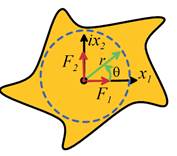 Finally, we need to verify that the
stresses are consistent with a point force acting at the origin. To do this, we can evaluate the resultant
force exerted by tractions acting on a circle enclosing the point force, as
shown in the figure. Since the solid is in static equilibrium, the total force acting on this circular
region must sum to zero. Recall that the
resultant force exerted by stresses on an internal surface can be calculated as
Finally, we need to verify that the
stresses are consistent with a point force acting at the origin. To do this, we can evaluate the resultant
force exerted by tractions acting on a circle enclosing the point force, as
shown in the figure. Since the solid is in static equilibrium, the total force acting on this circular
region must sum to zero. Recall that the
resultant force exerted by stresses on an internal surface can be calculated as
A unit normal to the circle is ; multiplying by the stress tensor
(in the basis) gives
Evaluating the integrals shows that , so as required.
5.3.4 Complex variable solution for
an edge dislocation in an infinite solid
A dislocation is an atomic-scale
defect in a crystal. The defect can be
detected directly in high-resolution transmission electron microscope pictures,
which can show the positions of individual atoms in a crystal. The leftmost figure below shows a typical example (an edge dislocation in a step-graded thin
film of AlGaAsSb, kindly provided by Prof. David Paine of Brown University). The dislocation is not easy to see, but can
be identified by describing a `burger’s circuit’ around the dislocation, as
shown by the yellow line. Each straight
portion of the circuit connects nine atoms.
In a perfect crystal, the circuit would start and end at the same
atom. (Try this for yourself for any
path that does not encircle the dislocation).
Since the blue curve encircles the dislocation, it does not start and end on the same atom. The `Burger’s vector’ for the dislocation is
the difference in position vector of the start and end atom, as shown in the
picture.

A continuum model of a dislocation
can be created using the procedure illustrated in the right-hand figure above. Take an elastic solid, and cut part-way
through it. The edge of the cut defines
a dislocation line .
Next, displace the two material surfaces created by the cut by the
burger’s vector b, and fill in the
(infinitesimal) gap. Note that (by convention) the burger’s vector specifies
the displacement of a point at the end of the Burger’s circuit as seen by an
observer who sits on the start of the circuit, as shown in the picture.
HEALTH WARNING: Some texts define the Burger’s vector to be the negative of the vector
defined here that is to say, the vector pointing from the
end of the circuit back to the start.
A general Burger’s vector has three components
the component parallel to the dislocation line is known as
the screw component of b, while the two remaining components are known as the edge components of b.
The stress field induced by the dislocation depends only on and b,
and is independent of the cut that created it.
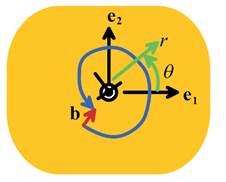
The figure above illustrates a pure edge dislocation, with line direction parallel
to the axis and burgers vector at the origin of an infinite solid. The
displacements and stresses can be derived from the complex potentials
The displacement and stresses (in polar coordinates) can be
derived from these potentials as
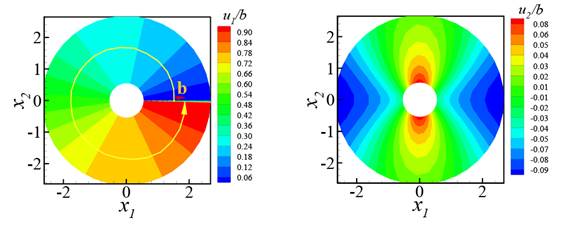
The displacement components are
plotted below, for a dislocation with .
The contours show a sudden jump in at (This is caused by the term involving in the formula for - we assumed that when plotting the displacement contours).
Physically, the plane corresponds to the `cut’ that created the
dislocation, and the jump in displacement across the cut is equal to the
Burger’s vector.
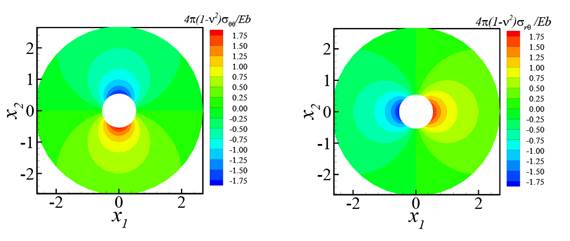
Contours of stress are plotted below.
The radial and hoop stresses are equal,
and compressive above the dislocation, and tensile below it, as one would
expect. Shear stress is positive to the right
of the dislocation and negative to the left, again, in concord with our
physical intuition. The stresses are
infinite at the dislocation itself, but of course in this region linear elasticity
does not accurately model material behavior, because the atomic bonds are very
severely distorted.
5.3.5 Cylindrical hole in an infinite solid under remote loading
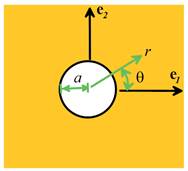 The figure shows a circular
cylindrical cavity with radius a in
an infinite, isotropic linear elastic solid. Far from the cavity, the solid is
subjected to a tensile stress , with all other stress components
zero.
The figure shows a circular
cylindrical cavity with radius a in
an infinite, isotropic linear elastic solid. Far from the cavity, the solid is
subjected to a tensile stress , with all other stress components
zero.
The solution is generated by complex potentials
The displacement and stress states are easily calculated as
5.3.6 Crack in an infinite elastic solid under remote loading
The figure below shows a 2D crack with
length 2a in an infinite solid, which
is subjected to a uniform state of stress at infinity. The solution can be generated by
complex potentials
Here, the notation indicates that you should substitute into the function , and
then take the conjugate of the whole function. Since gets conjugated twice, is actually a function of . It is
an analytic function, and its derivative with respect to z can be calculated as .
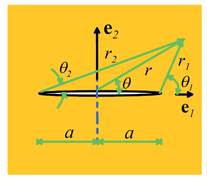
Some care is required to evaluate the square root in the complex
potentials properly (square roots are multiple valued, and you need to know
which value, or `branch’ to use.
Multiple valued functions are made single valued by introducing a `branch
cut’ where the function is discontinuous.
In crack problems the branch cut is always along the line of the
crack). For this purpose, it is helpful
to note that the appropriate branch can be obtained by setting
where the angles and distances and are shown above, and the angles and must lie in the ranges ,
respectively.
The solution is most conveniently expressed in terms of the polar
coordinates centered at the origin, together with the
auxiliary angles and . The displacement (for plane strain
deformation) and stress fields are
5.3.7 Fields near the tip of a crack
on bimaterial interface
 The figure shows a semi-infinite crack, which lies in the plane, with crack tip aligned with the axis.
The material above the crack has shear modulus and Poisson’s ratio ; the material below
the crack has shear modulus and Poisson’s ratio . In this section we give the complex variable
solution that governs the variation of stress and displacement near the crack
tip. The solution is significant because
all interface cracks (regardless of
their geometry and the way the solid is loaded) have the same stress and
displacement distribution near the crack tip.
The figure shows a semi-infinite crack, which lies in the plane, with crack tip aligned with the axis.
The material above the crack has shear modulus and Poisson’s ratio ; the material below
the crack has shear modulus and Poisson’s ratio . In this section we give the complex variable
solution that governs the variation of stress and displacement near the crack
tip. The solution is significant because
all interface cracks (regardless of
their geometry and the way the solid is loaded) have the same stress and
displacement distribution near the crack tip.
Additional elastic
constants for bimaterial problems
To simplify the
solution, we define additional elastic constants as follows
1. Plane strain moduli ,
2. Bimaterial modulus
3. Dundur’s elastic constants
Evidently
is a measure of the relative stiffness of the
two materials. It must lie in the range for all possible material combinations, with signifying that material 1 is rigid, while signifies that material 2 is rigid. The second parameter does not have such a
nice physical interpretation it is a rough measure of the relative
compressibilities of the two materials.
For Poisson’s ratios in the range , one can show that
that .
4. Crack tip singularity parameter
For
most material combinations the value of is very small typically of order 0.01 or so.
The full
displacement and stress fields in the two materials are calculated from two
sets of complex potentials
where and are parameters that resemble the mode I and
mode II stress intensity factors that characterize the crack-tip stresses in a
homogeneous solid. In practice these
parameters are not usually used in fracture criteria for interface cracks instead, the crack tip loading is
characterized the magnitude of the stress intensity factor , a
characteristic length L, and a phase angle , defined
as
This means
that .
Complete expressions
for the displacement components and stress components at a point in the solid can be calculated from these
potentials. To simplify the results, it
is helpful to note that
Then, in material 1
while in material 2
The individual stress components can
be determined by adding/subtracting the last two equations and taking real and
imaginary parts. Note that
.
Features of this solution are discussed in more detail in
Section 9.6.1.
5.3.8 Frictionless rigid flat
indenter in contact with a half-space
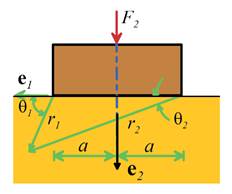 The figure shows a rigid, flat punch
with width 2a and infinite length
perpendicular to the plane of the figure. It is pushed into an elastic
half-space with a force per unit out of plane distance. The half-space
is a linear elastic solid with shear modulus and Poisson’s ratio . The interface between the two
solids is frictionless.
The figure shows a rigid, flat punch
with width 2a and infinite length
perpendicular to the plane of the figure. It is pushed into an elastic
half-space with a force per unit out of plane distance. The half-space
is a linear elastic solid with shear modulus and Poisson’s ratio . The interface between the two
solids is frictionless.
The solution is generated from the
following complex potentials
where is an arbitrary constant, representing an unknown
rigid displacement. Note that the solution is valid only for .
Stresses and displacements can be
determined by substituting for and into the general formulas, or alternatively,
by substituting into the simplified representation for
half-space problems given in 5.3.1. Some
care is required to evaluate the square root in the complex potentials,
particularly when calculating and . The
solution assumes that
where the angles and distances and are shown in Figure 5.26, and and must lie in the ranges .
The full displacement and stress
fields can be determined without difficulty, but are too lengthy to write out
in full. However, important features of
the solution can be extracted. In
particular:
1. Contact pressure: The pressure exerted by the indenter on the elastic solid follows as
2. Surface displacement: The displacement of the surface is
Note that there is no
unambiguous way to determine the value of .
It is tempting, for example, to attempt to calculate by assuming that the surface remains fixed at
some point far from the indenter.
However, in this case increases without limit as the distance of the
fixed point from the indenter increases.
3. Contact stiffness: the stiffness of a contact is defined as the ratio of the force acting on
the indenter to its displacement , and is of considerable interest in
practical applications. Unfortunately,
the solution for an infinite solid cannot be used to estimate the stiffness of
a 2D contact (the stiffness depends on ). Of
course, the stiffness of a contact between two finite sized elastic solids is well
defined but the stiffness depends on the overall
geometry of the two contacting solids, and varies as , where R is a characteristic length comparable to the specimen size, and a is the contact width.
5.3.9 Frictionless parabolic
(cylindrical) indenter in contact with a half-space
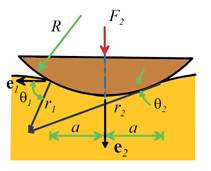 The figure shows a rigid, parabolic punch with profile
(and infinite length perpendicular to
the plane of the figure), which is pushed into an elastic half-space by a force
. This profile is often used to
approximate a cylinder with radius R. The interface between the two solids is
frictionless, and cannot withstand any tensile stress. The indenter sinks into the elastic solid,
so that the two solids make contact over a finite region , where
The solution is generated from the
following complex potentials
where is an arbitrary constant, representing an unknown
rigid displacement. Note that the solution is valid only for . You can use the formulas given
at the end of Section 5.3.1 to determine displacements and stress directly from
. In addition, the formulas in 5.3.7 should be
used to determine correct sign for the square root.
Important features of the solution are:
1. Contact pressure: The pressure exerted by the indenter on the elastic solid follows as
2. Surface displacement: The vertical displacement of the surface is
As discussed in 5.3.8, or the contact stiffness cannot be determined
uniquely.
3. Stress field
where
4. Critical load required to cause yield. The elastic
limit is best calculated using the Tresca yield criterion, which gives
where Y is the tensile yield stress of the solid. To derive this result, note that the stresses
are proportional to .
This means we can write
where is the stress induced at for a contact with a=1 subjected to load .
The yield criterion can therefore be expressed as
where denotes maximizing with respect to position in
the solid. The figure below shows contours of : the maximum value is approximately
0.3823, and occurs on the symmetry axis at a depth of about .
Substituting this value back into the yield criterion gives the result.

5.3.10 Line contact between two
non-conformal frictionless elastic solids
The solution in the preceding section
can be generalized to find stress and displacement caused by contact between
two elastic solids. The solution
assumes:
1. The two contacting solids initially
meet at along a line perpendicular to the plane of the figure (the line of
initial contact lies on the line connecting the centers of curvature of the two
solids)
2. The two contacting solids have radii
of curvature and at the point of initial contact. A convex surface has a positive radius of
curvature; a concave surface (like the internal surface of a hole) has a
negative radius of curvature
3. The two solids have Young’s modulus
and Poissons ratio and .
4. The two solids are pushed into
contact by a force
The solution is expressed in terms of an effective contact
radius and an effective modulus, defined as
The contact width and contact
pressure can be determined by substituting these values into the formulas given
in the preceding section. The full
stress and displacement field in each solid can be calculated from the
potential given in the preceding section, by adopting a coordinate system that
points into the solid of interest.
5.3.11 Sliding contact between two rough
elastic cylinders
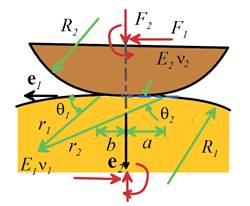 The figure shows two elastic cylinders with elastic constants , radii , and infinite length perpendicular to the plane
of the figure, which are pushed into contact by a forces acting perpendicular to the line of contact,
and acting parallel to the tangent plane. The interface between the two solids has a
coefficient of friction , and cannot withstand any tensile
stress. The tangential force is
sufficient to cause the two solids to slide against each other, so that . We give the solution for solid (1)
only: the solution for the second solid can be found by exchanging the moduli
appropriately.
The figure shows two elastic cylinders with elastic constants , radii , and infinite length perpendicular to the plane
of the figure, which are pushed into contact by a forces acting perpendicular to the line of contact,
and acting parallel to the tangent plane. The interface between the two solids has a
coefficient of friction , and cannot withstand any tensile
stress. The tangential force is
sufficient to cause the two solids to slide against each other, so that . We give the solution for solid (1)
only: the solution for the second solid can be found by exchanging the moduli
appropriately.
The coordinate system has origin at
the initial point of contact between the two solids. The two solids make
contact over a finite region , where
and
Only the derivatives of the complex potentials for this
solution can be found analytically: they are
Note that the solution is valid only
for . You can use the formulas given
at the end of Section 5.3.1 to determine stresses directly from . In addition, the branch of must be selected so that
where the angles and distances and are shown in Figure 5.29, and and must lie in the ranges .
Important features of the solution
are:
1. Contact pressure: The tractions exerted by the indenter on the elastic solid follow as
In practice, the value of is very small (generally less than 0.05), and
you can approximate the solution by assuming that without significant error.
2. Approximate expressions for stresses. For , the stresses can be written in a
simple form. The stresses induced by the
vertical force are given in Section 5.3.8.
The stresses resulting from the friction force are
where
5.3.12 Dislocation near the surface
of a half-space
 The figure shows a dislocation with
burgers vector located at a depth h below the surface of an isotropic linear elastic half-space, with
Young’s modulus and Poisson’s ratio .
The surface of the half-space is traction free.
The figure shows a dislocation with
burgers vector located at a depth h below the surface of an isotropic linear elastic half-space, with
Young’s modulus and Poisson’s ratio .
The surface of the half-space is traction free.
The solution is given by the sum of
two potentials:
where
is the solution for a dislocation at position in an infinite solid, and
corrects the solution to satisfy the
traction free boundary condition at the surface.
The displacement and stress fields
can be computed by substituting and into the standard formulas given in Sect 5.3.1
(do not use the half-space representation).
A symbolic manipulation program makes the calculation painless. Most
symbolic manipulation programs will not be able to differentiate the complex conjugate
of a function, so the derivatives of and should be calculated by substituting
appropriate derivatives of and into the following formulas
As an example, the variation of stress along the line is given by
